Thursday, March 6, 2014

Be There or Be Square

“All religions, arts and sciences are branches of the same tree.  All these aspirations are directed toward ennobling man’s life, lifting it from the sphere of mere physical existence and leading the individual towards freedom.”
- Albert Einstein, “Moral Decay”, 1937


Any list of “must see” places in Iowa would be woefully incomplete without including the Grotto of the Redemption in West Bend.  Although essentially a religious shrine anyone who visits will be moved at this amazing display of one man’s devotion.


This multi-layered complex of grottos was the expression of gratitude to Mother Mary by Father Paul Dobberstein.  It consists primarily of a number of interconnected grottos occupying multiple levels, connected by ramps and stairs that sometimes wind through the massive structure.


Built by hand of rocks, precious, and semi-precious stones the Grotto seems out of place in the cornfields of Northwestern Iowa.  The structure of the complex includes agate, amethyst, azurite, malachite, drusy quartz, calcite, barite, jasper, and even petrified wood.  The stones come from all over the world, including Oklahoma, Brazil, and the Andes Mountains.


As a young seminarian Father Dobberstein was stricken with a severe case of pneumonia.  He prayed to the Virgin Mary to intercede, and eventually recovered from his illness.


In 1898 Father Dobberstein was assigned to Sts. Peter and Paul church in West Bend, Iowa.  There he began stock piling the stones and rocks he would need for his vision.  Construction of the Grotto began in 1912.


Father Dobberstein did have help with his labors.  In 1912 Matt Szerensce, straight from high school, took a job as grotto collaborator, and started a 52 year career of intense labor.  No one knows for sure how many total hours the two men worked, but every stone of the grotto was lifted by hand.


When Father Dobberstein was 74 years old Father Greving was sent to West Bend to take over Dobberstein's clerical duties.  Father Dobberstein was eventually called home, on July 24th, 1954.  Greving and Szerensce continued the work.  In 1959 Matt Szerensce finally retired.
 

The complex is made of 9 separate Grottos, each depicting a scene in the life of Christ.  A moving depiction of Mother Mary holding the body of Jesus beneath the cross adorns the peak of the structure.  Statues include not only the birth and crucifixion of Jesus, but Adam and Eve being expelled from the Garden, and Moses presenting the Commandments. The complex also includes a garden area to sit in quiet contemplation.


The Grotto grounds includes not only the Grotto itself and Sts Peter and Paul Church, but also includes a campground, a cafĂ©,  and a gift shop.  Between the Grotto and the campgrounds a small pond is home to a flock of swans.


Also on the grounds is a museum with it’s own collection of gem stones.  They also show a video depicting the history of the Grotto.


The Grotto of the Redemption is not only the largest man made grotto in the world, it is also the largest collection of precious stones and gems in the world.  A definite must see in Iowa, it is estimated that 100,000 tourists have visited the Grotto.


Oscar Wilde wrote, “No great artist ever sees things as they really are.  If he did, he would cease to be an artist.”  We can be forever grateful to Father Dobberstein for sharing his vision.
 
And if you go, say hi to the swans for me.

Wednesday, March 5, 2014

Greenbelt

 
"I like this place and could willingly waste my time in it."
- William Shakespeare
 
 
One of my favorite places to go and shoot is the Greenbelt Park in Clive, Iowa.  The park is just a few minutes drive from work, so it's a great place to spend my lunch time.


Readers from the Des Moines area may be familiar with the Greenbelt Park, the rest of you will I hope enjoy the photos.  (Hint: click on any photo to view the photos as a slide show). 


The Greenbelt Park straddles Walnut Creek as it meanders through Clive, Iowa.  The bike trail that runs through the park continues to the east down through Water Works Park and all the to downtown.  To the west the trail continues on to Waukee and the Raccoon Valley Trail.


 For those looking to see deer, here's my advice on the best place to go and get up close and personal.  Go to the Greenbelt entrance at 86th Street, by the 7 Flags Fitness Center.  Follow the road into the woods to the shelter house. 

From there head to the west until you get to the side trail that leads to Lincoln Ave (there should be a park bench there).  Look for the tree shaped like a number 4.


To your right, just in front of the tree, is a small trail.  Follow it, and keep your eyes open for deer, squirrels, foxes, and in season herons nesting along the creek.

For mallard duck enthusiasts the best place to spot them is just east of the 86th Street bridge over Walnut Creek.  Go about 30 yards, then start watching the creek!


There's plenty of wildlife in the woods of the trail, and you can get surprisingly close to some of them.  Most of them are semi-acclimated to people, so if you're not too loud or scary you should be able to get close.

The Clive portion of the Greenbelt runs from the near the Windsor Heights Wal-Mart to almost 149th Street in Clive.  On a good day a two or three hour hike will get you from one end to the other.  If you're not feeling that energetic there are plenty of parking areas along the way.

All the photos in today's blog were taken along the Greenbelt Trail.  So if you're in the Des Moines area take the time to have your own little adventure.  Until then, enjoy the show!


Monday, March 3, 2014

Raging

And you, my father, there on the sad height,
Curse, bless, me now with your fierce tears, I pray.
Do not go gentle into that good night.
Rage, rage against the dying of the light.
 - Dylan Thomas

There are things I like to do in a certain way, and I don’t want to change how I do them.  The older I get the more I seem to rely on these habits. 

It isn’t a question of simply not wanting to change, of being “set in my ways.”  It has more to do with the feeling that if I do change these things then I am giving in to my age.  I do them because it's the way a younger man would behave.

Some of these things may seem like they aren’t very important.  In the big scheme of things you’re right, they aren’t important.  Yet to me they are highly symbolic.

Take as an example my bed. 

It was summer when I first got my cat Eartha Kitty and brought her home.  The apartment didn’t have air conditioning, so there was a ceiling fan going in both the living room and the bedroom.

I opened the cat carrier she was in and set her on the floor.  She looked up, saw the fans spinning above her head and absolutely freaked.  She went running into the bed room, and managed to squeeze through a hole in the bottom of the box springs of my bed.

There she stayed for three days.  For three days I tried coaxing her out with food and water, and for two nights I slept on the couch so she wouldn’t get hurt by the springs.

When she finally came out of the bed I pulled the mattress and box spring onto the floor to prevent her from getting back inside.  My intent at the time was to buy a sheet of plywood and cut it to the right size to cover the bottom of the box spring, but I just never got around to it.

Eventually I started to like having the mattress on the floor.  It became a source of pride to me that not only did I still manage to get my tuckus out of bed each morning, I had to raise it an extra 10-15 inches other people didn’t.  My morning struggle to rise was harder, therefor I was more youthful.  I was a badass.

And now, I have a wonderful, patient, and very forgiving wife to consider.  So I’ve decided to give in on this one. We ordered a new bed online yesterday. 

Another thing I don’t like giving in on is shoveling the driveway by hand.  If there’s 6 inches of heavy wet snow I’ll drag out the snow blower.  I may be a bit stubborn, but I’m not a fool.  Well, not that much of one.

It is yet another source of pride that a man my age (somewhere between 29 and 99) can still shovel a 3 inch layer of snow off the driveway.  Running the numbers, that’s 324,000 cubic inches of snow.  By weight that’s 2,812.5 lbs of snow, about 1.5 tons.  In 30 minutes.

Not bad for an old man!  Perhaps it is all senility.  Perhaps it is all vanity.  Then again, perhaps it is all vanity.

Think about the words of French author Jules Renard, “It’s not how old you are, it’s how you are old.”

There are other little things that I do to keep young.  Things like taking the stairs instead of the elevator at work, since it’s just one floor.  A little lack of oxygen never hurt anyone. 

Men do lots of silly things to try to keep feeling youthful.  Some go and find younger girl friends, but I’m already married to the most wonderful woman I know.  Some buy expensive muscle cars, but I have neither the time, money, nor the temperament to keep an old Mustang running. Some like to buy clothes that are meant for 18 year olds, but really shouldn’t be worn by anyone.

Ever.

For myself I do admit to keeping the buttons on my polo shirts undone to show off my masculine chest.  Although now I’ve been informed that my graying hairs look like lint. 

Oh well, what are you going to do?

In all fairness women also have their little tricks and rituals that they use to keep young.  The cosmetics industry makes billions of dollars every year on everything from shampoos to foot lotions that are guaranteed to make you look and feel 10 years younger.  Clothing manufacturers now make under garments with so much support they shame the designers of the Golden Gate Bridge.

Of course, my wife doesn’t need to use any of that stuff.

So on we go, all of us aging more or less gracefully, doing what we can to keep time from having his way with us.  And does it really matter if your weapon of choice in the war against time is a lotion, a girdle, a Corvette, or just showing your chest hair while you shovel snow? 

Because it really is just a matter of attitude.  Maybe you don’t have to rage against the dying of the light, but at least get seriously miffed.  Maybe just hold your head up as high as you can, and face the world with your best smile, dentures and all.  You are as young as you feel.

As playwrite George Bernard Shaw observed, “You don’t stop laughing when you grow old, you grow old when you stop laughing.”

Now, where did I put that darn Ben-Gay?

Sunday, March 2, 2014

The Yin and The Yang of Catholicism

"Don't canonize me too soon. I'm perfectly capable of fathering a child."
- Francis of Assisi

Where ever you look in the world of the spiritual you seem to find this natural dichotomy, two opposites in tension that create a reality through that mutual tension. 

In Eastern philosophical schools those two opposites are referred to as the yin and the yang.  Each force begets the other, each force can not exist without the other.

Tonight I attended another interesting presentation on the beliefs of Catholicism at Christ the King church.  The episode tonight was about the apostles Peter and Paul.  Mary was not mentioned.

I will offer here my own caveat, the opinions expressed herein are my own, and are intended to spark thought and introspection.  I'm also glad they no longer burn heretics.

These two saints were presented as crucial to the creation and existence of the church.  And it is because the two are a type of yin and yang of priests that they are able to do this.

Let's first consider St. Peter.  Jesus made him the leader of that band of brothers known as the 12 apostles.  Peter was entrusted with the keys of heaven.  And Jesus called him the rock on which he would build his church.

Peter was a priest's priest.  He was the foundation of the church, and as such the bearer of the status quo.  The line of popes that begin with Peter's appointment by God  must, as a function of being "a foundation," maintain tradition. 
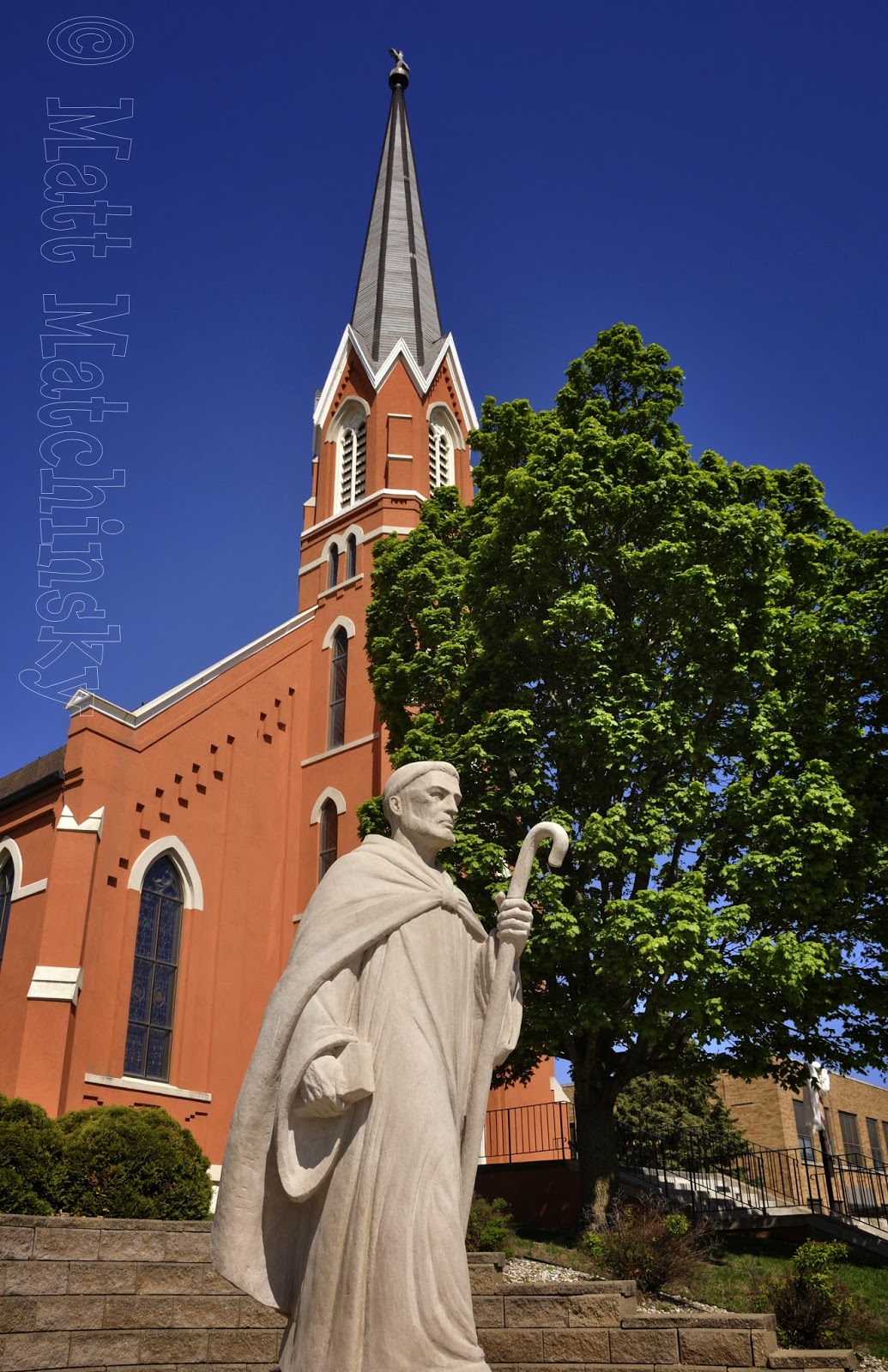
Paul was the opposite.  After starting his career by persecuting the Christians, Paul had a divine visitation, and was converted.  He then began his second career as an evangelist.

Paul was a priest more along the shamanic lines, at least in comparison to Peter.  Paul was converted after a devastating, singular incident.  His behavior became what would have been considered odd for the times, at least odd to his friends. 

"Paul," they would have said to him in worried tones. "You've changed, dude.  Maybe you should look into one of those 12 step programs."  They would have been concerned.

Where Peter's role was to maintain, Paul's role was to disrupt.  Where Peter's role was to preserve a heritage, Paul's role was to re-invent a heritage. 

I know, but stay with me for just one second.

Because the role of Peter was concerned largely with the church as a social establishment, his base of operations was located in Rome, the center of civilization and government.  He was more static, had his pulse on the latest news.  Peter was urbane and metropolitan. 

Because the role of Paul was more concerned with spiritual awakenings he did not have a static kind of life.  Paul was on the move, he was exploring, he was interpreting a message based on the traditions of the people he evangelized.  His base of operations was Greece, the center of spirituality and philosophy. 

So we have two men, the yin and the yang of the early church.  They should also serve as archetypes for priests of today.  And it is crucial to keep in mind that these priestly archetypes can, will, and should exist within the same person.  As yin and yang each has it's moments in the sun.

The priest must fulfill the role of functionary, conserving the traditions of the faith.  At other times a priest must be able to call upon his experiences and wisdom to deal with unforeseeable circumstances and events. 

He must be bureaucrat and pioneer in one person.  He must be both warden and fellow inmate, both father and brother, both Abbot and Costello.  But not Punch and Judy.

Of course as fellow saints they both had much in common.  Their commonality is shared with all people, we're all sinners.  Yet saints have always had a way of going that extra mile in their youth when it comes to sin.

As  Soren Kierkegaard writes, "God creates out of nothing. Wonderful you say.  Yes, to be sure, but he does what is still more wonderful: he makes saints out of sinners."

There is one particular image from tonight that will stick with me.  It was a photo of a statue of St. Peter, holding in his hand the key to heaven.  From the angle of this particular shot Peter is looking down at the key he holds, and the look on his face is one of shock and horror.  As if to say, "Oh dear God, don't give me this responsibility!"

But God did, and Peter accepted.  That's how God makes saints out of sinners.

Must be time for supper.  I thought I heard someone say "steak."

Saturday, March 1, 2014

Communication and Erector Sets

 
"But if thought corrupts language, language can also corrupt thought."
- George Orwell, "1984"
 
So there is this story in the Bible called the Tower of Babel. 
 
From the way I understand it, a bunch of really smart folks, Mesopotamians I think, got together and started to build a tower.  The purpose of the tower was to help all these smart Mesopotamians get closer to God.  
 
Apparently God was not too pleased with the plan, perhaps he was afraid property values around the pearly gates would go down.  The plan must have come close to succeeding, because God did something about it.  And if the plan was doomed to fail, why bother?
 
And what an intriguing way for God to fix their wagon!  God reached down to the Earth and smote the builders of the Tower of Babel. 
 
And what a smiting they got!  From that moment forward, they all started to speak different languages.  And so the construction on the tower came to a halt, and they all wandered off.
Now, the simple thing would have been for God to simply destroy the tower, maybe drop a plague on the Mesopotamians, and that would have been the end of it.  Yet perhaps God's little remedy had another, less obvious purpose?
 
For one thing, the urge to build towers to bring us closer to God was never silenced.  We all still carry that impulse to get closer to God.
 
That innate drive still moves us, in ways that are both literal and metaphorical.  We strive to get closer to God through meditations, and to reach for the heavens in architectural expressions. 
 
Many churches, at least the ones that don't look like a pre-fab shoe warehouse, have spires that reach to the heavens.  That architecture is an outward symbol of our hopes to commune with God.  Or at the very least to insure that our thoughts and prayers are carried skyward.
 
Secular structures also favor a towering view of the world when the budget, building codes, and soil conditions allow it.  There is something that fascinates us standing in high places, looking down at the Earth with a God's eye view.
 
It wouldn't be too far of a stretch to ascribe the space race to this same impulse.  To travel out into the heavens, to see the other worlds that God created, and look back upon the Earth with a God's eye view beyond anything dreamed of 100 years ago.
 
Given that the impulse to approach God was not quelled when construction was halted and mankind scattered, then what was God's other reason?
 
Philosopher, linguist, and logician Ludwig Wittgenstein wrote,  "The limits of my language means the limits of my world."
 
So here are my thoughts on just what God was up to.   
 
Mankind's impulse to approach God was a milestone of sorts.  This desire was not one that troubled God.  This was neither a group sin nor was it a desire God wanted to discourage.  Yet God knew that mankind was not yet mature enough.
 
Mankind needed to populate and explore the Earth, and perhaps lands beyond.
 
Language, as Wittgenstein said, is a kind of limit.  The Mesopotamians had lived too long within a very narrowly defined environment, and that limited their understanding of the world, and their ability to have the wisdom needed to grow closer to God.
 
So mankind was scattered, as was his language.  He gained new tools to understand the world, new ways of expressing his thoughts, hopes, dreams, and fears.  Some languages were very similar, holding only subtle differences.  Some languages were wildly different, having no apparent common roots. 
 
Yet they all have one thing in common, they are all expressions of the human mind and heart.
 
Mankind's next challenge is to take all he has come to know and bring that knowledge into combined wisdom.  
 
So far we're failing that test.  We face each other with an almost impenetrable wall between us.  Instead of acknowledging what we have in common, and enriching each other with what is different, we fill the space between us with suspicion, and sometimes hatred.
 
Author Antoine de Saint-Exupery wrote, "Language is the source of misunderstandings."   There is a lot of truth in that statement, and it points directly to the irony of the situation.  The differences in language that could be tools for a deeper and richer understanding of the world have instead become blinders. 
 
It is even worse when language makes the divisions between us wider.  What begins as a simple misunderstanding is turned into warfare by self-centered egos.  That has to change, we need to find ways to make our differences enrich each others lives.
 
After all, we have a tower to rebuild.